
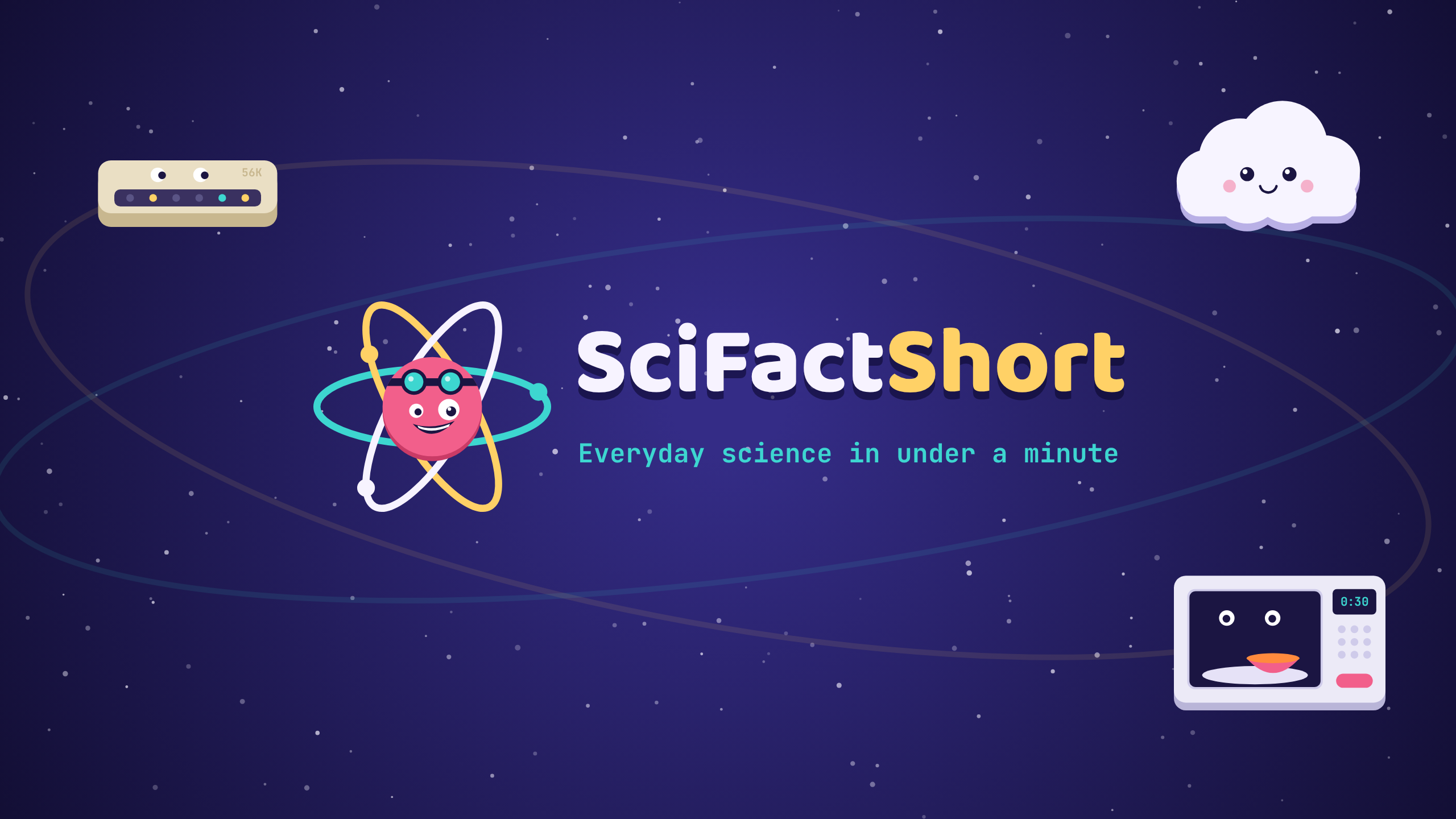
TL;DR — Visit my new YouTube channel and subscribe.
At about half past one in the morning, I decided I might like to make a science channel.
By lunchtime, I’d launched one.
I did sleep in between. Before this turns into one of those posts about how much you can achieve if you simply stop having normal bodily requirements.
The channel is SciFactShort: animated science and tech explainers, around 45 seconds to a minute long, offering soft, playful ways into everyday questions. 🎨
Why does a microwave spin your food? How heavy is a cloud? Why does your phone battery give up when it gets cold?
And, for a younger audience who may find this difficult to believe: what was dial-up internet?
Yes, we used to phone the internet. It screamed at us while connecting, occupied the household telephone line and occasionally caused a family argument.
I’m talking as though most of my readers don’t remember engaged telephone lines and images downloading line by line. Sorry. We’ve all aged beautifully.
1:35am: I could make something with this
The starting point was a PBS Space Time video about perpetual motion machines. It got me thinking about science education and whether I could make something easier to approach.
The audience I had in mind has never known a time when you couldn’t click a button and reach an extraordinary amount of information. Having access to an explanation is almost taken for granted.
But you still need a reason to become curious. And sometimes you need a friendly place to start.
That was the feeling I wanted to follow.
One question. Something familiar enough to recognise, with something hiding inside it that you might never have considered.
You’ve seen a cloud. You’ve probably never tried to weigh one. You use a microwave. You might never have wondered why your dinner goes round.
There’s a small invitation in each of those questions. You already know enough to join in.
I wanted to turn that invitation into a video.
Before bed: give the modem a face
The first episode was “What was dial-up internet?”
For many of us, a modem was part of our first experience of going online. A beige box that connected the computer in your house to an enormous world outside it.
You heard it doing the work. The dialling, the screeching, the negotiation. Going online was an event, sometimes accompanied by somebody asking how long you were going to be.
For the audience I’m making these videos for, that experience is unfamiliar. Their internet is simply there.
So the modem in the animation got a friendly face.
I liked the connection in that. This little object had once helped us find our way onto the internet. Now it could help someone find their way into understanding how that happened.
The face gave the viewer someone to follow. You could watch the modem trying to make a connection, rather than start with a technical description of what a modem does.
Through those small scenes, an unfamiliar system became something you could recognise: a conversation, a wait, an interruption.
That was the creative idea I wanted to keep exploring. Give people something comfortable to approach, then help them discover what’s going on.
The finished animation was 43 seconds long. By about quarter to two, I had a video and a list of possible follow-ups.
Then I went to bed.
The next morning: follow the invitation
At around 10:24, I picked two more questions: why microwaves spin your food, and how heavy a cloud is.
One was more for the item-in-your-house-but-I-don’t-know-how-it-works explainer videos. The other was a genuine science-surprise: a cloud is as heavy as a 100 elephants! What?!?
A cloud looks light. What happens when you put its weight on a set of scales and bring in some elephants?
The subject is science. Making the video is a creative act.
I’m choosing what someone encounters first, what gives them confidence to keep watching and which comparison might help an explanation click.
A friendly character can do that. So can a visual joke, a familiar situation or a question you can’t quite leave unanswered.
There won’t necessarily be a face on everything. I’m not working towards a universe in which every household appliance requires eyes.
The feeling is more consistent than that: soft, playful, easy to enter.
The look belongs to the idea
That thinking carried into the visual direction.
Deep indigo backgrounds, rounded shapes, yellow, teal and pink. Clear captions, with the important words picked out. Movement that gives you something to follow.
I liked the warmth of flat animation and the possibilities it gave me for explaining things you can’t ordinarily see. You can go inside a battery, give a cloud some weight or let two modems have a conversation.
I wanted each episode to offer a small, satisfying piece of understanding. The sort that leaves you thinking “ohhh”, then perhaps asking another question.
Forty-five seconds won’t tell you everything about clouds. It can make you look at one differently.
That feels like a worthwhile thing to make.
11:22am: the atom was too cute
By late morning, it had a name: SciFactShort.
The episodes were beginning to belong together. Then came the logo.
One option was an atom mascot. I liked it, but the face was too cute.
Soft and friendly still needs some personality. I wanted curiosity with a little mischief in it. A raised eyebrow. The suggestion that this character had an experiment underway and probably hadn’t mentioned it to the appropriate authorities.
Two expressions emerged: the Schemer and the Mad Scientist.
The Mad Scientist won. Goggles pushed up, mismatched eyes, enormous grin. There was somebody who looked pleased to have discovered something and keen to show you.
I emailed it to a friend I knew would love it.
That’s a good feeling: making something that amuses you, then immediately wanting somebody else to see it. Little tip for anyone who has a creative friend: don’t show too much interest, because they’ll ask for your reaction to every expression tweak, background graphic, and video adjustment… To that friend who shall we remain nameless, whoops and sorry :).
By lunchtime, it existed
The videos went into Google Drive. The ideas, publishing dates and descriptions went into Notion. There was a YouTube banner and a home on my website.
The organisation of knowing where to put the files and where to put copy and images was important to me. I’m not a very organised person so having a clear view of files goes here and text goes there was important. The other bit about the organisation was that organisation doesn’t have to be perfect! Notion might not have been the best place and Google Drive might not have been the best place. But it worked. And in this case working is better than perfect.
By roughly half past twelve, I’d launched the channel.
YouTube Shorts, Instagram Reels and TikTok suited the idea. A question can meet someone while they’re scrolling. They don’t need to have decided to study science or search for an explanation.
Perhaps they stop because they recognise the object. Perhaps the question surprises them. Perhaps there’s a beige modem making an unreasonable noise.
The opening only needs to earn enough curiosity for them to stay.
I like the possibility of that encounter: a small explanation arriving in the middle of someone’s day and giving them something to take away.
I kept making. Teletext. Cold phone batteries. VHS tapes. Why you can’t tickle yourself. Why the sky is blue. How your phone knows where you are.
By early afternoon, nine episodes had been produced, with more to release over the following days.
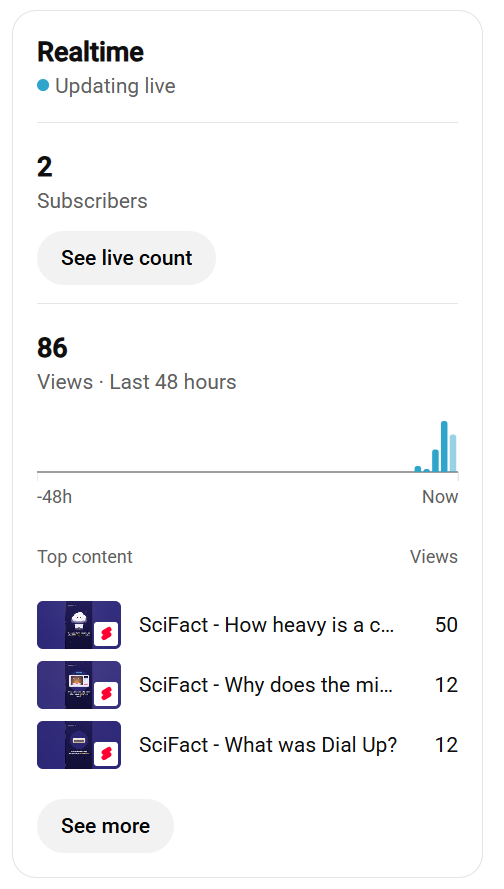
In the first three hours I had a little bit of traction, a few viewers but nothing to write home about. I didn’t do anything to promote the videos. As I’ve always said to clients: you have to find ways to tell people that your content exists. Promotion is of course the next part of the cycle for me. Then analysis of what’s starting to work. Then more content.
The first videos used captions, synthesised effects and a soft synth music bed, with voiceover still to come. There were things to add and things to improve.
There is a tendancy to want to go back over the old videos and ‘fix’ things that you discover during the creative process. My advice: that is almost always a bad idea. Keep moving forward and evolve what you’ve got. If that idea of evolving your creative live gets you scared, I suggest you go back and look at the very first episodes of The Simpsons. They’ve been going for 36 years and, wow, have they evolved over the years!
I didn’t want to perfect the enthusiasm out of it
I could have spent weeks preparing this.
I know enough about the creative process and marketing to generate a substantial amount of preparation if left unsupervised. Audience research. More visual routes. More naming options. A slightly different eyebrow.
Some of that might have improved the channel. Some might simply have used up the energy that made me want to create it.
I didn’t want to spend a hundred-million hours perfecting the possibility.
I had a feeling. The moment told me there was something worth following, and I had enough in front of me to act on it.
I was making judgements all the way through. The atom changed because its personality wasn’t right. The questions earned their place because I could see an inviting way into them. The episodes developed a shared look because they belonged to the same idea.
I could keep making those decisions while also letting the work exist.
Twelve hours, plus everything that came before
There’s a large qualification to the speed of this.
I’m luckier than most in the tools I have at my disposal. Creative experience, design, AI expertise, marketing. I can move between having an idea, making it and getting it in front of people.
I also grew up alongside the internet. Some of the early episodes draw on things I remember using, waiting for and occasionally shouting at.
That experience gives me material. The tools give me ways to do something with it.
AI made the production speed possible. My experience helped me recognise the direction I wanted and make the decisions that kept it moving.
So, yes, about twelve hours elapsed between the idea and the launch, including sleep. A few hours of actual work.
But I brought rather more than twelve hours of experience to it.
What excites me is how close an idea can now be to something I can actually make while I still feel the urge to make it.
A little closer to Monster House
This also feels like a precursor to Monster House, my children’s book series.
There’s a connection in the way a character can invite you into something. You become interested in who they are, follow what happens to them and find yourself exploring a world along the way.
SciFactShort gives me another place to work with that instinct. How do you make something approachable? What makes somebody curious? How much personality can a small expression carry?
A face on a modem is one answer. There will be others.
For now, making this has got that part of me moving. I’ve followed a creative feeling far enough for other people to encounter it.
Now people get to see it
You can find SciFactShort on YouTube, TikTok and Instagram.
I’m interested to see which questions catch people, what they remember and what they ask next.
At half past one in the morning, I had a feeling about a science channel. By lunchtime, a little beige modem was helping explain the internet.
It used to be our way in. I quite like giving it that job again.
Fancy a conversation about this? Find me on LinkedIn or X, or drop a comment below.